LedgerSpring
Your Business Has Grown. Have Your Accounting and Financial Processes Kept Up?
LedgerSpring provides CPA-led accounting, controllership, and finance-operations advisory services to help growing service businesses maintain reliable financial reporting, strengthen oversight, and improve financial processes.
CPA-led. 20+ years across accounting, financial management, internal controls, and business operations.

Services
Based in Illinois, serving clients nationwide.
ACCOUNTING
Accounting Services
Starting at $495/month
Reliable Accounting and Timely Financial Reporting
Ongoing accounting services to maintain reliable records, manage the month-end close, and provide financial reporting and insights that help you understand how your business is performing.
General ledger management
Account reconciliations
AP/AR tracking and analysis
Month-end closing
Financial statement preparation
KPI and trend analysis
CONTROLLERSHIP
Controllership Services
Starting at $1,450/month
Experienced Financial Oversight for Growing Businesses
Already have a bookkeeper or accounting team? LedgerSpring provides experienced oversight, reviews financial reports, and strengthens accounting procedures and controls without a full-time controller.
Accounting oversight and supervision
Month-end close oversight
Financial reporting and analysis
Internal controls and procedures
Accounting workflow coordination
FINANCE OPS RESET
Finance Operations Reset
Starting at $1,950 (One-time assessment)
Find Out What's Holding Your Finance Operations Back
A structured assessment to identify weaknesses in your financial operations, investigate potential causes, and recommend practical improvements before you commit to significant changes.
Accounting processes and workflows
Financial and management reporting
Internal controls
Systems and technology
Roles and responsibilities
Different Financial Needs Require Different Solutions
As your business grows, your accounting and financial oversight needs change. The right support depends on what your business already has and where additional expertise is needed.

01 · ACCOUNTING
When Accounting Takes Time Away From Running Your Business
Your business needs accurate records and timely financial statements, but managing reconciliations, closing the books, and coordinating accounting work takes time away from running the business.
LedgerSpring provides ongoing accounting services to keep your financial records current and your monthly reporting on track.
02 · CONTROLLERSHIP
When Financial Oversight Becomes Essential
You already have a bookkeeper or accounting team handling the daily work. But who reviews the financial reports, oversees the monthly close, and ensures accounting issues receive appropriate attention?
LedgerSpring provides experienced controllership support to strengthen financial oversight and help management make better-informed decisions.

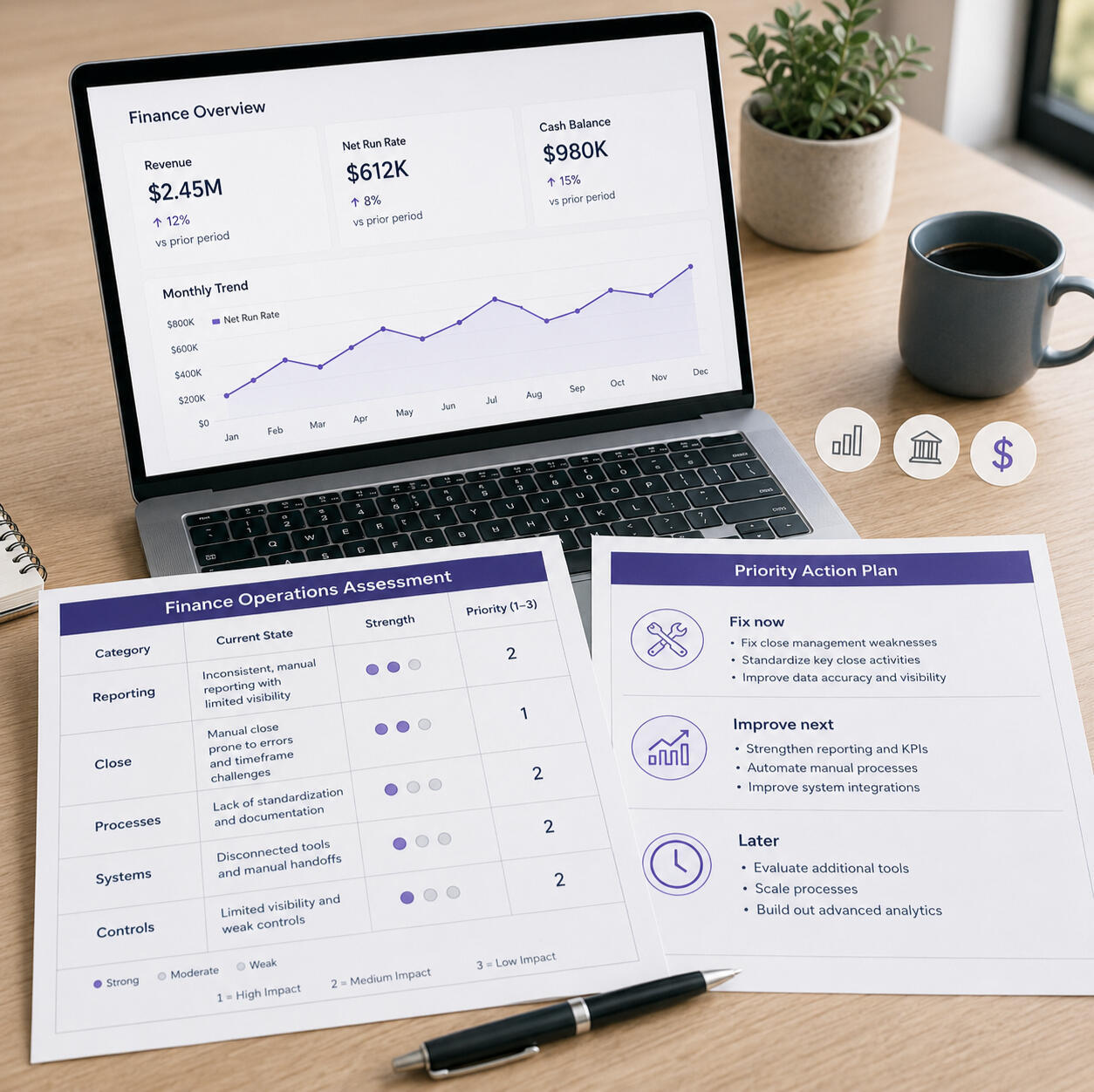
03 · FINANCE OPERATIONS RESET
When You're Not Sure What Breaks and What Needs to Improve
Financial reports are delayed, accounting work requires repeated corrections, or manual processes are consuming more time. You know something needs to improve, but the cause isn't clear.
The Finance Operations Reset investigates potential causes and recommends practical improvements before you commit to additional staff, new software, or major process changes.
Have Questions About Our Services?
Find answers about our services, pricing, and how we work with clients.
Let's Discuss What Your Business Needs
Whether you're looking for reliable accounting, experienced financial oversight, or help improving your financial processes, we can discuss your situation and determine whether LedgerSpring's services are a good fit.
About LedgerSpring
Experienced Financial Judgment for Growing Businesses
Based in Illinois, serving clients nationwide.
LedgerSpring is led by Mai Luu, CPA, CMA, CFE, with more than 20 years across accounting, financial management, internal controls, and business operations.That experience brings a broader perspective to client work. Beyond maintaining accurate financial records, LedgerSpring considers the accounting procedures, responsibilities, controls, and reporting practices that support reliable financial information and effective management oversight.

Featured Articles
Why Finished Financial Reports Do Not Show How Well Your Accounting Process Works
Completed financial reports don't guarantee strong accounting processes. Recurring corrections, manual work, and weak controls can create hidden costs and affect financial reliability.
Read the article →
When a Growing Business Outgrows Its Accounting Support
As a business grows, its accounting needs change. Greater complexity may require stronger accounting practices, financial reporting, and oversight.
Read the article →
Making Sure Your Accounting Works as a Whole
Discover how better accounting coordination and oversight can improve financial reporting, reduce your workload and support better business decisions.
Read the article →
Why Revenue Growth Doesn't Always Lead to Higher Profits
Higher revenue doesn't always mean higher profits. Understand how pricing, service delivery costs and growth decisions affect profitability and where opportunities for improvement may lie.
Read the article →
Contact Us
Send a message
Tell us a little about your business and the services you're interested in. We'll review your inquiry and follow up about next steps, including a 20-minute introductory conversation if appropriate.

©2026 LedgerSpring. All rights reserved.
Thank You
Your inquiry has been submitted successfully.
We'll review your message and follow up to discuss the next steps, including arranging a 20-minute introductory conversation if appropriate.
Reliable Accounting. Timely Financial Reporting.
CPA-Led Accounting Services for Growing Service Businesses
LedgerSpring handles your ongoing accounting, reconciliations, and month-end close, delivering reliable monthly financial statements and actionable financial insights to help you better understand your business's performance.
Services starting at $495/month

Choose the Right Level of Accounting Support
From reliable monthly accounting to enhanced financial reporting and analysis, LedgerSpring provides CPA-led accounting services tailored to your business's needs.
CORE
Accounting Core
Starting at $495/month
For single-entity service businesses with straightforward transactions, a limited number of accounts, and reasonably current accounting records.
What's Included
General ledger maintenance and transaction classification
Bank, credit card, and other agreed account reconciliations
Light AR/AP tracking
Routine month-end closing and adjusting entries
Review of significant account balances and accounting issues
Monthly balance sheet and income statement
Monthly financial summary highlighting significant changes and accounting matters requiring attention
Routine accounting-related communication within the agreed scope
Recommended ESSENTIAL
Accounting Essentials
Starting at $895/month
For businesses that need more than financial statements but do not require extensive customized reporting or ongoing controllership.
Includes Core, Plus
Monthly Financial Health Snapshot highlighting key results and items requiring attention
Visual financial dashboard with agreed Key Performance Indicators (KPIs)
Monthly cash flow reporting and analysis
Monthly Accounts Receivable (AR) aging reports, overdue balance tracking, and aging trend analysis
Monthly Accounts Payable (AP) aging reports, upcoming payment visibility, and aging trend analysis
Revenue, profitability, and cash flow trends
Month-over-month financial comparisons
Expanded financial commentary and management insights
ADVANCED
Accounting Advanced
Custom pricing based on scope
For businesses with more complex accounting requirements or a need for customized financial reporting and analysis.
Everything in Essentials, plus:
Accounting support for higher transaction volumes and more complex operations
Accounting support for multiple entities and complex reconciliations, as agreed
Customized financial dashboards and Key Performance Indicators (KPIs)
Budget-to-actual comparisons and variance analysis
Detailed revenue, profitability, and expense analysis
Enhanced Accounts Receivable (AR) and Accounts Payable (AP) reporting
Customized management reports and financial insights
Additional accounting support based on agreed business needs
Pricing & Scope Notes
Monthly fees vary based on transaction volume, complexity, and reporting needs. QuickBooks Online is our primary accounting platform.
Onboarding: Routine onboarding is included at no additional charge.
Historical Cleanup: Catch-up bookkeeping and significant corrections are quoted separately.
Invoicing and Bill Payments: Available separately upon request, subject to scope.
Services Outside the Standard Scope: Payroll processing, tax preparation, and assurance services are not offered. Software implementations and specialized projects are quoted separately.
Have More Questions?
Find answers to common questions about our accounting services, monthly reporting, and how we work with clients.
When Your Business Needs Accounting Support
Accounting Is Taking Too Much of Your Time
You're managing a growing business, but accounting responsibilities continue to demand your attention.
You need someone you can rely on to manage the ongoing accounting work, so you can spend more time on your customers, your team, and your business.

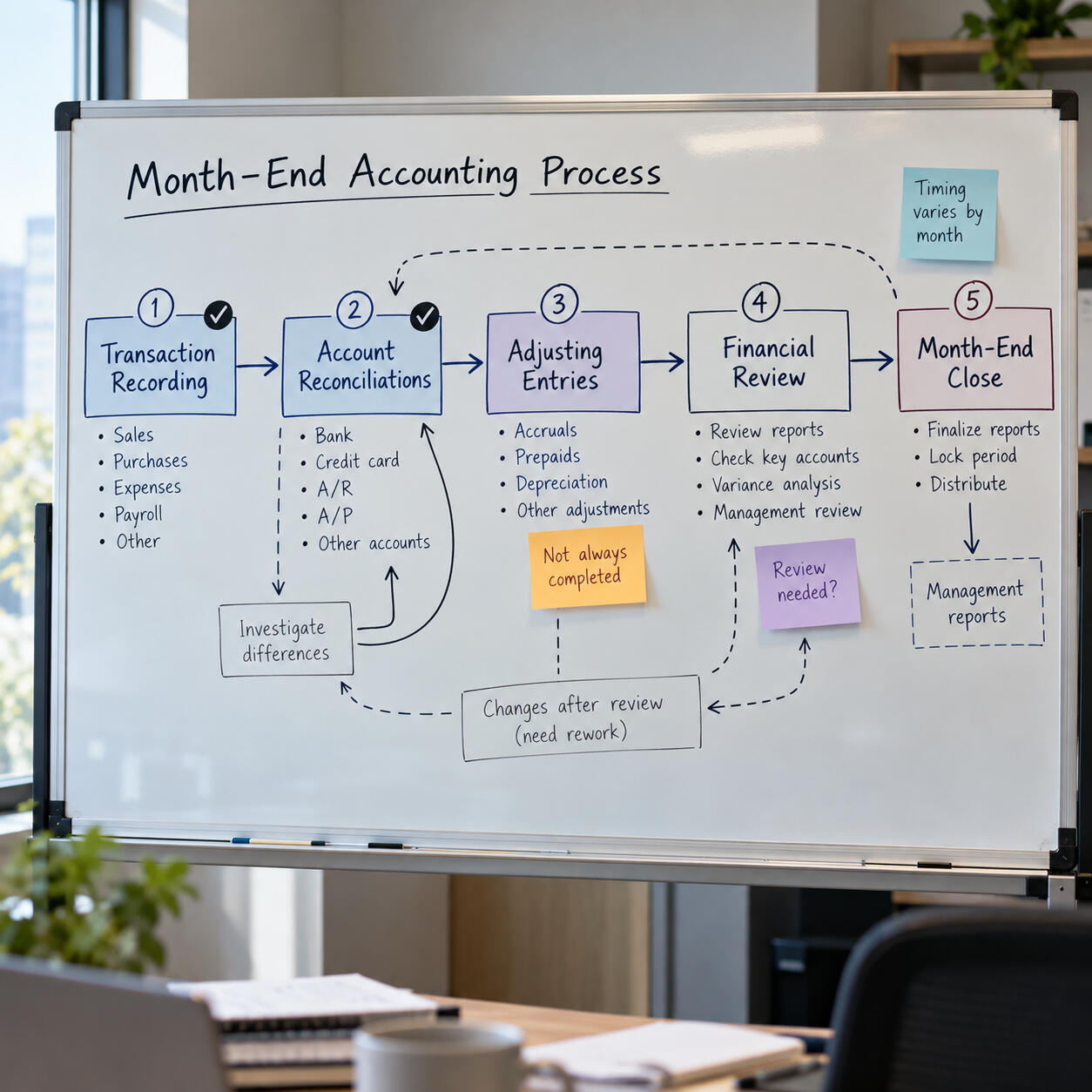
Your Accounting Process Is Inconsistent
Your transactions may be recorded, but are your accounts reconciled? Have important adjustments been made? Can you rely on the numbers you're seeing?
You shouldn't have to wonder whether your accounting is being handled properly. A consistent monthly accounting process helps give you confidence in your financial records.
Financial Reports Arrive Too Late to Be Useful
You want to know how your business is performing, but financial reports may arrive late or leave important questions unanswered.
With timely financial statements and meaningful insights, you can better understand changes in revenue, expenses, and profitability—and make decisions with greater confidence.

How We Work With You
01 - Understand Your Accounting Needs
We discuss your business operations, existing accounting systems, current challenges, and reporting requirements to recommend the appropriate service package and scope.
02 - Establish the Accounting Workflow
We review your accounting setup, clarify responsibilities, identify outstanding issues, and establish an agreed monthly closing and reporting process.
03 - Manage Your Monthly Accounting
We maintain accounting records, complete reconciliations, review account balances, and perform agreed month-end closing procedures.
04 - Deliver Financial Reports & Insights
We provide monthly financial statements and financial insights according to your selected service package, highlighting significant trends, changes, and matters requiring attention.
CPA-Led Accounting Experience
LedgerSpring is led by Mai Luu, CPA, CMA, CFE, with more than 20 years of experience across accounting, financial management, internal controls, and business operations.
We bring professional judgment and a practical business perspective to monthly accounting, financial reporting, and performance analysis.
Our focus is not simply maintaining accounting records, but helping businesses establish dependable financial information they can use with confidence.
Who We Work Best With
LedgerSpring provides ongoing accounting and financial reporting services to U.S. businesses seeking reliable financial information and professional accounting support.
A Good Fit for Businesses That:
Need consistent, professionally managed monthly accounting.
Want to delegate accounting responsibilities or work alongside existing administrative staff.
Value timely financial statements and meaningful financial insights.
Need a more structured accounting and reporting process as their business grows.
Can provide timely financial records, system access, and supporting information.
Seek an ongoing accounting relationship rather than occasional bookkeeping assistance.
We primarily work with QuickBooks Online. Other accounting systems may be considered based on your business's requirements.


When Another Service May Be More Appropriate
01 - Controllership Services
Already have a bookkeeper or accounting team but need experienced oversight, financial reporting review, and stronger accounting controls?
Explore Controllership Services →
02 - Finance Operations Reset
Experiencing recurring accounting problems, inefficient workflows, or unreliable financial reporting? Our Finance Operations Reset helps identify underlying issues and develop prioritized recommendations for improvement.
Let's Get Your Monthly Accounting on Track and Your Financial Picture in Focus
Whether you need reliable monthly accounting or deeper insight into cash flow and business performance, LedgerSpring can help you find the right level of support.
Schedule a 20-minute discovery call to discuss your accounting needs, reporting priorities, and the service package that best fits your business.

©2026 LedgerSpring. All rights reserved.
Experienced Accounting Oversight. Stronger Financial Reporting.
CPA-Led Controllership Services for Growing Service Businesses
LedgerSpring works with your existing bookkeeper or accounting team to provide ongoing accounting oversight, strengthen month-end closing and financial reporting, and address issues that require experienced accounting judgment.
Services starting at $1,450/month

What's Included in Our Controllership Services
As your business grows, accounting responsibilities can become more complex. Experienced oversight helps ensure important accounting work is reviewed, reporting issues receive appropriate attention, and financial responsibilities are clearly defined.
Month-End Close Oversight: Oversee monthly closing activities, review completion of key procedures, and help resolve issues affecting financial reporting.
Accounting Review & Oversight: Review significant reconciliations, account balances, and adjusting entries prepared by your existing accounting personnel. Investigate unusual items, provide guidance on accounting treatment, and follow up on issues requiring correction.
Financial Reporting & Analysis: Review monthly financial statements, analyze significant changes and trends, and provide a financial dashboard and management summary based on agreed reporting requirements and key performance indicators.
Internal Controls Review: Evaluate selected accounting controls, identify weaknesses, and recommend practical improvements appropriate to your business.
Accounting Workflow Coordination: Clarify responsibilities, coordinate recurring accounting activities, and help establish more consistent financial processes.
Accounting & Management Support: Provide experienced guidance on accounting questions, financial reporting issues, and matters requiring management attention.
CONTROLLERSHIP SERVICE PRICING
Starting at $1,450/month
Monthly fees are tailored to your business based on the complexity of your accounting function, the number of entities and accounts, reporting requirements, the level of oversight needed, and the agreed scope of services.
We'll review your current accounting arrangements, recommend an appropriate service scope, and provide a customized quote.
Have More Questions?
Find answers about controllership services, financial oversight, and working with your existing accounting team.
When Your Business Needs Controllership Support
Your Bookkeeper Needs Experienced Oversight
Your bookkeeper manages day-to-day transactions, but reviewing reconciliations, resolving more complex accounting questions, and evaluating financial statements may require additional expertise. You need experienced oversight without necessarily hiring a full-time controller.


Month-End Closing Is Difficult to Manage
Accounting activities are being performed, but closing responsibilities, reviews, and deadlines aren't consistently coordinated. You need a more structured process with clearer responsibilities and accountability.
Your Financial Reports Need More In-Depth Analysis
You receive financial statements, but the numbers alone don't always explain what's changing in your business. You need experienced review, meaningful financial analysis, and clearer insight into important trends and issues.

What You Can Expect
Stronger Oversight. More Reliable Reporting. Clearer Accountability.
LedgerSpring provides ongoing controllership support to strengthen the review, coordination, and financial reporting practices of your existing accounting function.
Experienced Accounting Oversight: Important accounting work receives review from an experienced accounting professional, with issues identified and addressed within the agreed scope.
More Consistent Month-End Closing: Clear responsibilities and review procedures help support a more predictable and organized closing process.
More Useful Management Reporting: A monthly financial dashboard and management summary help you understand significant financial trends, performance indicators, and matters requiring attention.
Clearer Responsibilities & Communication: Accounting personnel and management have a more structured approach to coordinating work, resolving issues, and addressing reporting concerns.
Specific responsibilities, dashboard metrics, reporting deliverables, and service levels are established in each engagement.
How We Work With You
01 - Understand Your Accounting Function
We review your existing accounting arrangements, team responsibilities, financial reporting requirements, and areas where additional oversight may be needed.
02 - Establish Oversight Procedures
We define review responsibilities, communication expectations, month-end closing procedures, reporting schedules, and appropriate dashboard metrics.
03 - Provide Ongoing Controllership Support
We review agreed accounting work, oversee relevant closing activities, address accounting questions, and coordinate with your existing personnel.
04 - Communicate Findings & Follow Up
We review monthly financial results, provide the agreed dashboard and management summary, discuss significant observations, and track unresolved issues.
CPA-Led Accounting & Financial Management Experience
LedgerSpring is led by Mai Luu, CPA, CMA, CFE, with more than 20 years of experience across accounting, financial management, internal controls, and business operations.
This experience brings a practical perspective to accounting oversight, financial reporting, internal controls, and the processes that support growing businesses.
Who We Work Best With
A Good Fit for Businesses That:
Have an existing bookkeeper, accountant, or accounting team.
Need ongoing review and oversight of accounting activities.
Want more consistent month-end closing and financial reporting.
Need experienced accounting judgment without hiring a full-time controller.
Value stronger internal controls, clearly defined responsibilities, and accountability.
Can provide timely access to accounting records and coordinate with existing personnel.
Our services are designed for ongoing controllership engagements rather than occasional accounting reviews.


When Another Service May Be More Appropriate
01 - Accounting Services
If you need LedgerSpring to manage your ongoing accounting, reconciliations, month-end closing, and monthly financial reporting, explore our Accounting Services.
02 - Finance Operations Reset
If recurring accounting or financial reporting problems require broader investigation before choosing a solution, our Finance Operations Reset can help assess the issues and prioritize next steps.
Let's Strengthen Your Accounting Oversight
If your business has an existing bookkeeper or accounting team but needs experienced oversight and financial reporting support, LedgerSpring can provide ongoing controllership services tailored to your needs.
Schedule a 20-minute discovery call to discuss your accounting arrangements, reporting requirements, and the level of support your business needs.

©2026 LedgerSpring. All rights reserved.
Find Out What's Holding Your Finance Operations Back
The Finance Operations Reset investigates recurring accounting problems, delayed financial reporting, and inefficient processes to identify potential causes and provide practical, prioritized recommendations for improvement.
Assessments starting at $1,950.
Choose the Right Level of Assessment
Each Finance Operations Reset follows LedgerSpring's seven-area assessment framework. The depth of investigation and recommendations vary based on your business's complexity and needs.
CORE
Reset Core
$1,950
A focused assessment for relatively straightforward operations and defined concerns.
What's included
Assessment of one entity and one principal accounting platform
Review across seven assessment areas
Targeted financial record and process review
Focused management discussion
Evaluation of key weaknesses and potential causes
Written findings and recommendations
Prioritized next steps
Final review meeting
Featured COMPREHENSIVE
Reset Comprehensive
$2,950
A deeper investigation when problems recur or may be connected across accounting, systems, and workflows.
Includes CORE, plus
Assessment covering up to four agreed business platforms within one entity
Additional financial records and supporting evidence reviewed
Discussions with relevant accounting personnel
Walkthroughs of selected accounting workflows
Investigation of relationships between significant issues
Evidence-supported analysis of potential causes
Detailed improvement recommendations
90-day prioritized improvement roadmap
EXPANDED
Reset Advanced
Custom pricing based on complexity
For businesses with multiple entities, complex systems, or interconnected workflows requiring deeper investigation.
Customized scope may include
Assessment of multiple entities and/or more than four business platforms, as agreed
Expanded management and employee interviews
Cross-functional workflow and control analysis
Review of intercompany workflows, transactions, and relationships across related entities.
Detailed review of significant system dependencies
Evaluation of improvement alternatives and tradeoffs
Expanded recommendations and implementation roadmap
Additional management review discussions
The appropriate package, scope, timeline, and deliverables are confirmed before engagement. The Finance Operations Reset provides assessment and recommendations. Implementation is not included.
Have More Questions?
Find answers about the Finance Operations Reset, assessment scope, timelines, and what to expect.
CPA-Led Accounting & Financial Management Experience
LedgerSpring is led by Mai Luu, CPA, CMA, CFE, with more than 20 years of experience across accounting, financial management, internal controls, and business operations.
This experience brings a practical perspective to evaluating financial processes, identifying accounting and operational weaknesses, and recommending improvements that support growing businesses.
Signs Your Business May Need a Finance Operations Reset
Your accounting and financial processes may still be built for the business you used to have, not the business you are running today.
Recurring accounting problems: Corrections, reconciliation issues, or reporting errors keep returning.
Delayed financial reporting: Month-end closing takes too long, leaving management waiting for information.
Increasing manual work: Spreadsheets, duplicate entry, follow-up, and rework consume more time.
Limited financial visibility: Management receives reports but still struggles to obtain timely, useful information.
Unclear responsibilities: Important activities depend on particular employees, with inconsistent oversight or approvals.
Uncertainty about solutions: You're considering more staff, new software, or automation but aren't sure what will solve the problem.
Understand the Cause Before Choosing the Solution
Hiring another employee, replacing software, or introducing automation may help. But without understanding the underlying causes, these changes may not resolve the problem.
The Finance Operations Reset investigates significant weaknesses, evaluates potential causes, and helps management prioritize improvements.

What We Review
The Finance Operations Reset examines seven interconnected areas to understand how your accounting and financial operations function and where improvements may be needed.
Financial Reporting: Accuracy, timeliness, consistency, and usefulness of financial information provided to management.
Cash Visibility and Cash Flow Management: How cash balances, upcoming cash requirements, and cash-flow information are monitored and managed.
Month-End Close: Closing procedures, reconciliations, recurring corrections, bottlenecks, and reporting delays.
Accounting and Financial Workflows: Manual activities, duplicate work, information handoffs, follow-up, and process inefficiencies.
Systems and Technology: How financial systems work together, where limitations exist, and how technology affects accounting workflows.
Internal Controls and Accountability: Approvals, oversight, segregation of duties, responsibilities, and dependence on key employees.
Readiness for Growth: Whether existing processes, systems, and responsibilities can support increasing business complexity.
The depth of investigation depends on the selected Reset package and agreed scope.
What You Receive
Clear Findings. Practical Recommendations. Prioritized Next Steps.
The Finance Operations Reset provides documented findings on your financial operations, with practical recommendations and prioritized next steps based on the assessment.
FINANCE OPERATIONS FINDINGS: Documented observations, identified weaknesses, and associated risks across the areas reviewed.
IMPROVEMENT RECOMMENDATIONS: Practical actions to address weaknesses in accounting processes, reporting, controls, responsibilities, and systems.
PRIORITIZED NEXT STEPS: Recommended actions organized by priority, helping management understand which issues need attention first and which improvements can be addressed over time.
FINAL REVIEW MEETING: A discussion of the findings, recommendations, and priorities, with an opportunity to clarify next steps.
The depth of analysis and detail of the deliverables depend on the selected Reset package and agreed scope.
How It Works
From Initial Conversation to Practical Recommendations
01
Confirm the Fit
Understand your needs and agree on the scope.
02
Gather Information
Obtain relevant records and process information.
03
Conduct the Assessment
Evaluate evidence and develop findings and recommendations.
04
Review Next Steps
Receive your findings and discuss recommended priorities.
Assessment timelines are confirmed before engagement and depend on scope and information availability.
Is the Finance Operations Reset Right for Your Business?
The Finance Operations Reset is designed for growing service businesses with established accounting operations that need an independent assessment of their financial processes.
A Good Fit for Businesses That:
Have existing accounting records and financial reporting processes.
Use QuickBooks Online or another agreed-upon accounting system.
Can provide relevant financial records and process information.
Have management and accounting personnel available to participate in the review.
Are willing to review findings and consider practical improvements.


When Another Service May Be More Appropriate
01 - Accounting Services
If you need ongoing management of your accounting records, reconciliations, month-end closing, and monthly financial reporting, explore our Accounting Services.
02 - Controllership Services
If you already have a bookkeeper or accounting team but need experienced oversight, financial reporting review, and stronger accounting controls, explore our Controllership Services.
Let's Understand What's Behind Your Finance Operations Challenges
If recurring accounting problems, reporting delays, or inefficient workflows are affecting your business, let's discuss what you're experiencing.
During a 20-minute introductory call, we can determine whether a Finance Operations Reset is appropriate and which assessment level may best fit your needs.

©2026 LedgerSpring. All rights reserved.
Frequently Asked Questions
Find answers about LedgerSpring's services, pricing, and how we work with clients.
General Questions
What types of businesses does LedgerSpring work with?
LedgerSpring works with small, service-based businesses across the United States. We provide accounting, controllership, and finance operations services tailored to each business's needs and complexity.
How do I know which service is right for my business?
That depends on your current challenges. Accounting Services focuses on maintaining accurate records and delivering timely financial reports. Controllership Services provides deeper financial oversight and analysis. Finance Operations Reset addresses accounting processes, reporting gaps, and operational inefficiencies that need focused improvement. We'll help you determine the right starting point during an introductory call.
How are your services priced?
Pricing depends on the service, scope of work, and complexity of your needs. Our recurring Accounting Services packages have published starting prices, while more specialized engagements are priced based on their requirements. We'll explain the proposed scope and fees before work begins.
How do we get started?
Schedule an introductory call to discuss your business, current challenges, and priorities. We'll assess whether LedgerSpring is a good fit, recommend an appropriate service, and outline the proposed scope, pricing, and next steps.
Accounting Services
What's the difference between Accounting Core, Essentials, and Advanced?
Core covers essential monthly accounting and financial reporting. Essentials adds dashboards, KPIs, and deeper financial insights. Advanced provides customized accounting and reporting for businesses with more complex needs.
What financial reports will I receive each month?
All packages include an income statement, balance sheet, and financial summary. Essentials adds a Financial Health Snapshot, dashboard, cash flow reporting, and AR/AP aging reports. Advanced reporting is tailored to your needs.
Do you work with QuickBooks Online?
Yes. QuickBooks Online is our primary accounting platform.
What if my books are behind or need cleanup?
We can assess your records and recommend the necessary cleanup. Historical cleanup and catch-up work are quoted separately.
Do you provide payroll, tax preparation, invoicing, or bill payment services?
We do not provide payroll or tax preparation services. Customer invoicing and vendor bill payments may be available upon request and are quoted separately.
Controllership Services
How is controllership different from accounting services?
Accounting Services handle the ongoing accounting work, including reconciliations, month-end closing, and financial statement preparation. Controllership Services provide oversight and review of work performed by your existing bookkeeper or accounting team, along with guidance on accounting issues and financial reporting.
What does LedgerSpring's Controllership Services include?
Services may include financial statement review, budget-to-actual analysis, cash flow oversight, management reporting, and recommendations to strengthen financial controls.
Do I need to use LedgerSpring for accounting to receive controllership services?
No. We can work alongside your existing bookkeeper or accounting team, provided the financial records are sufficiently reliable.
How often will we review financial performance?
Typically monthly, with the frequency and reporting deliverables tailored to your business needs and agreed scope.
How are Controllership Services priced?
Pricing is customized based on your business's complexity, reporting requirements, and level of financial oversight needed.
Finance Operations Reset
What is a Finance Operations Reset?
Finance Operations Reset is a focused assessment of accounting processes, financial reporting, and related workflows. It identifies significant issues, investigates potential causes, and provides prioritized recommendations for improvement.
How is Finance Operations Reset different from monthly accounting services?
Monthly accounting provides ongoing recordkeeping and financial reporting. Finance Operations Reset assesses existing processes, identifies underlying issues, and recommends prioritized improvements.
What types of problems can Finance Operations Reset address?
Common issues include delayed month-end closing, inconsistent reconciliations, unreliable reporting, unclear responsibilities, and inefficient accounting workflows.
How do I know which Finance Operations Reset package is right for my business?
The appropriate package depends on your business's complexity, the number of entities and systems involved, and the depth of investigation needed. We'll review your situation and recommend a package with a clearly defined scope before the engagement begins.
How long does a Finance Operations Reset take?
The timeline depends on the scope of the assessment, complexity of the issues, and availability of records and personnel. We'll confirm the expected timeline before the engagement begins.
Do I need to become a monthly accounting client afterward?
No. Finance Operations Reset is available as a standalone engagement. If ongoing accounting or controllership support would be beneficial, we can discuss those options separately.

©2026 LedgerSpring. All rights reserved.
Privacy Policy
Last updated: October 26, 2026This Privacy Policy explains how we collect, use, disclose, and safeguard your information when you visit this website www.ledgerspring.com or engage with our services. By using this site, you consent to the practices described below.1. Information We CollectPersonal Information: We may collect personal information you voluntarily provide, including:• Name.
• Email address.
• Business name.
• Business type.
• Any information submitted through contact forms, application forms, or downloads.Automatically Collected Information: When you visit our website, we may automatically collect:• IP address.
• Browser type.
• Device information.
• Pages visited and time spent
• Referring URLs.This data is collected via cookies, analytics tools, or similar technologies.2. How We Use Your InformationWe use the information collected to:• Respond to inquiries and applications.
• Deliver requested resources or services.
• Communicate about services, updates, or educational content.
• Improve website performance and user experience.
• Comply with legal and regulatory requirements.We do not sell your personal information.3. Cookies and Tracking TechnologiesThis website may use cookies and similar technologies to:• Understand how visitors use the site.
• Improve functionality and performance.
• Track marketing effectiveness.You can control cookie usage through your browser settings.4. Sharing of InformationWe may share your information with:• Service providers (e.g., email platforms, analytics tools, scheduling software) strictly to operate this website and our services.
• Legal or regulatory authorities if required by law.We do not share personal data with third parties for advertising resale.5. Data SecurityWe implement reasonable administrative and technical safeguards to protect your information. However, no method of transmission over the internet is 100% secure, and we cannot guarantee absolute security.6. Your Rights and ChoicesDepending on your location, you may have the right to:• Request access to your personal data.
• Request correction or deletion of your data.
• Opt out of marketing communications.To exercise these rights, contact us using the information below:
[email protected]7. Third-Party LinksThis website may contain links to third-party websites. We are not responsible for the privacy practices or content of those sites. Please review their privacy policies separately.8. Children’s InformationThis website is not intended for individuals under the age of 18. We do not knowingly collect personal information from children.9. Changes to This Privacy PolicyWe may update this Privacy Policy from time to time. Updates will be reflected by the “Last updated” date above. Continued use of the website constitutes acceptance of any changes.10. Contact UsIf you have questions about this Privacy Policy or how your information is handled, please contact us at [email protected]

©2026 LedgerSpring. All rights reserved.
Terms of Service
Last updated: October 26, 2026By accessing or using this website www.ledgerspring.com, you agree to be bound by these Terms of Service. If you do not agree with these terms, please do not use this website.1. Purpose of This WebsiteThis website provides:• Educational content related to accounting, management, and business finance.
• Information about services offered to small businesses.
• The ability to submit inquiries, applications, or requests for resources.Content on this site is for informational and educational purposes only.2. No Professional Relationship CreatedUse of this website does not create:• An accountant-client relationship.
• A CPA-client relationship.
• Any fiduciary or advisory relationship.A formal professional relationship is established only through a signed engagement agreement.3. No Investment, Tax, or Legal AdviceAll content provided on this website, including videos, guides, posts, and resources:• Is general in nature.
• Does not constitute investment, tax, or legal advice.
• Should not be relied upon as a substitute for professional advice tailored to your situation.You are responsible for consulting qualified professionals before making decisions.4. EligibilityBy using this website, you confirm that:• You are at least 18 years old.
• You have the legal capacity to enter into agreements.
• Any information you provide is accurate and truthful.5. User SubmissionsWhen you submit information through forms or applications, you agree that:• Information provided is accurate and not misleading.
• You will not submit unlawful, abusive, or harmful content.
• We may use submitted information to respond to inquiries or provide requested services.We reserve the right to reject or ignore submissions at our discretion.6. Intellectual PropertyAll content on this website—including text, graphics, videos, branding, and materials—is owned or licensed by us and protected by intellectual property laws.You may:• View and share content for personal, non-commercial use.You may not:• Copy, reproduce, sell, or distribute content without written permission.
• Represent our content as your own.7. Third-Party Tools and LinksThis website may reference or link to third-party tools, platforms, or websites. We are not responsible for:• Third-party content.
• Their availability or accuracy.
• Their privacy or data practices.Use third-party services at your own risk.8. Limitation of LiabilityTo the maximum extent permitted by law:• We are not liable for any direct, indirect, incidental, or consequential damages.
• We make no guarantees regarding outcomes, savings, or results.
• Use of this website and its content is at your own risk.9. IndemnificationYou agree to indemnify and hold harmless this website and its operators from any claims, losses, or damages arising from:• Your use of the website.
• Your violation of these Terms.
• Your reliance on website content.10. Modifications to These TermsWe reserve the right to update or modify these Terms at any time. Changes will be reflected by the “Last updated” date. Continued use of the website constitutes acceptance of updated terms.11. Governing LawThese Terms shall be governed by and interpreted in accordance with the laws of the United States, without regard to conflict of law principles.12. Contact InformationIf you have questions about these Terms of Service, please contact us through the contact form on this website.

©2026 LedgerSpring. All rights reserved.
Business & Financial Insights
Practical perspectives to help business owners understand financial challenges, make informed decisions and build stronger businesses.
Why Finished Financial Reports Do Not Show How Well Your Accounting Process Works
Completed financial reports don't guarantee strong accounting processes. Recurring corrections, manual work, and weak controls can create hidden costs and affect financial reliability.
Read the article →
When a Growing Business Outgrows Its Accounting Support
As a business grows, its accounting needs change. Greater complexity may require stronger accounting practices, financial reporting, and oversight.
Read the article →
Making Sure Your Accounting Works as a Whole
Discover how better accounting coordination and oversight can improve financial reporting, reduce your workload and support better business decisions.
Read the article →
Why Revenue Growth Doesn't Always Lead to Higher Profits
Higher revenue doesn't always mean higher profits. Understand how pricing, service delivery costs and growth decisions affect profitability and where opportunities for improvement may lie.
Read the article →
Why Profitable Businesses Still Experience Cash Flow Problems
A profitable business can still struggle to meet its financial obligations. Understand how billing, collections, payment timing and working capital affect cash availability.
The Hidden Cost of Not Keeping Your Accounting Up to Date
Falling behind on accounting can have consequences beyond additional cleanup costs. Discover how outdated financial information affects business decisions, financial visibility and the ability to address emerging problems.
What Your Financial Statements May Not Be Telling You
Standard financial statements provide an important overview of your business, but they may leave critical questions unanswered. Learn how more meaningful financial reporting can help you understand what drives business performance.
Why the Same Accounting Problems Keep Coming Back
Recurring accounting problems often originate outside the accounting records themselves. Understand how workflows, systems and responsibilities can contribute to persistent problems and what it takes to resolve them.
Can Your Business Afford Its Next Hire?
Hiring involves financial commitments beyond an employee's salary. Learn how to evaluate employment costs, expected financial returns and the risks of expanding your team.
What Happens When Your Business Relies Too Heavily on a Few Customers?
A small number of major customers can generate substantial revenue while exposing your business to considerable financial risk. Understand how customer concentration affects profitability, cash flow and financial stability.
Why Better Accounting Software Doesn't Always Solve Accounting Problems
New accounting software can improve efficiency, but technology alone cannot resolve every financial process weakness. Learn what to evaluate before investing in new systems.
How to Protect Your Business Without Overcomplicating Its Financial Processes
Effective financial controls can reduce costly errors, unauthorized spending and fraud risks. Understand how to establish appropriate safeguards without creating unnecessary administrative work.

©2026 LedgerSpring. All rights reserved.
Why Finished Financial Reports Do Not Show How Well Your Accounting Process Works
.
Your financial reports arrive every month. The books are closed, accounts are reconciled, and the numbers are ready.But how much work does it take to get there?Your accounting team may be spending hours correcting transactions, reconciling differences between systems, or tracking down missing information. And even after all that work, some errors may remain undetected.A completed financial report tells you what the accounting process produced. It doesn't necessarily tell you how well that process works.What Finished Reports Do Not ShowBy the time the financial statements reach the owner, all they see is the finished product.The numbers may be ready on time only because an experienced employee knows where the systems do not match and how to correct the recurring differences. Over time, that extra work becomes part of the routine.Because the expected report still gets produced, the owner may not see how inefficient the process has become or how much it depends on one person’s knowledge.One Process Weakness Can Create Two OutcomesFinancial reports are the final output of a longer process.Transactions may begin in the accounting system or in a billing, payroll, expense, or sales platform. The information has to be complete, classified correctly, moved between systems when necessary, and reviewed or reconciled.Consider a service business that needs a margin report by customer or service line. Employees must use the correct customer, project, or service codes when recording transactions. If they use those codes inconsistently, accounting has to investigate and reclassify the transactions before preparing the report.Accounting may identify and correct every classification problem. The final report would then be accurate, but producing it would require recurring investigation and delay the information management needs.Some incorrect classifications may remain. An unprofitable service could appear profitable, or one customer could appear more valuable than another. Management may then make pricing, hiring, or spending decisions using incorrect information.That same weakness can create extra work, bad information, or both.Manual work does not automatically produce inaccurate information. Reconciliations and reviews can identify many problems. But repeated data entry, unclear handoffs, inconsistent classifications, and undocumented adjustments create more opportunities for errors. A completed report does not prove that every error was found.Growth Increases the Cost and RiskA manual process or spreadsheet may work well when transaction volume is low and only a few people are involved. As the business grows, more people and systems handle the same information. Small inconsistencies begin creating more work.At lower volume, a recurring difference between two systems might take an hour to sort out. Once transaction volume grows, the same cleanup can consume most of a day. Before long, employees are turning to the owner regularly just to get the monthly work finished.The accounting team may work longer hours while less urgent but more strategically important work gets delayed, such as improving cash forecasts, analyzing margins, or correcting the process that keeps creating the extra work.At that point, management may conclude that the business needs another accounting employee. But more capacity does not fix the reason the extra work exists. It may simply allow the company to continue performing unnecessary work at a higher cost.Delayed information creates another cost. If accounting spends too much time assembling and correcting the numbers, management has less time to act on them.If the reports arrive weeks late, the owner may learn about a cash shortage only when payments are coming due. At that point, the company may have to delay payments or seek short-term financing instead of addressing the shortage earlier through stronger collections or spending decisions.Look at How the Information Is ProducedManagement should not evaluate the accounting operation only by whether they hit the monthly closing date.Start with the problems that return every month. What information arrives late or incomplete? Where do systems repeatedly fail to match? Which reports depend on spreadsheets or one employee’s knowledge? What important work gets delayed because the team spends its time correcting the same issues?That helps management see which work is actually necessary and which work exists because the process is weak.The answer may be as simple as clarifying who owns a task, changing how transactions are recorded, improving a handoff between departments, or making better use of an existing system. Before hiring another person or buying another system, management should first understand why the work keeps piling up.Reliable financial records remain essential. But completed financial reports do not prove that the accounting operation works efficiently or that every number is correct.Management needs to look at both the financial information and the process that produces it.How LedgerSpring Can HelpLedgerSpring helps small service-based businesses assess accounting processes, identify recurring issues, and determine where improvements may be needed.Explore Our Finance Operations Reset →
ABOUT THE AUTHORMai Luu, CPA, CMA, CFE, has more than 20 years of experience in accounting, finance, and business operations. Her background includes financial reporting, controllership, internal controls, and improving accounting processes and financial operations. She has also contributed articles to professional publications on accounting and business-related topics.

©2026 LedgerSpring. All rights reserved.
When a Growing Business Outgrows Its Accounting Support
.
A business can outgrow its accounting support even when the person keeping its books is doing a good job.Transactions are recorded, bank accounts are reconciled, and financial statements are prepared. Yet the owner may still be spending too much time resolving accounting questions, reports may be arriving later than expected, or the numbers may no longer provide enough information to understand how the business is performing.Often, the accounting arrangement was established when the company was much smaller. A part-time bookkeeper or basic bookkeeping service was sufficient because the owner handled many of the decisions and the accounting was relatively straightforward.The company may need more than additional bookkeeping hours. It may need stronger accounting review, a more consistent month-end close, and financial reporting that reflects its current operations.Growth Changes What the Accounting Function Must HandleConsider a consulting business that initially serves a small number of clients. The owner reviews invoices, approves expenses, and knows which projects are generating revenue. A bookkeeper handles the accounting records and reconciliations.As the company grows, it adds employees, project managers, and customers. Some clients pay monthly retainers. Others are billed based on hours worked or project milestones. Employees incur expenses that need to be recorded against the appropriate projects.
The bookkeeper now depends on information from several people, and that information does not always arrive complete.A project manager may submit billing details after the invoicing deadline. An employee's expense may be recorded without identifying the client or project. Someone has to follow up, determine the correct treatment, and make sure the records reflect what happened.
The workload has increased, but so has the need for coordination and accounting judgment.The business may also want information it never needed before. Which services are profitable? Are labor costs increasing faster than revenue? How much cash is tied up in unpaid customer invoices?
A bookkeeper hired primarily to record transactions and reconcile accounts may not have been engaged to provide that level of accounting and reporting support.As the business grows, the bookkeeper may find that the work now requires more than what was originally expected of them.More Bookkeeping Capacity Is Not Always the AnswerWhen accounting work increases, giving the bookkeeper more hours or hiring another person seems like a reasonable solution. If the business simply has more invoices, payments, and expenses to process, that may be exactly what is needed. There is no reason to complicate a straightforward staffing decision.But consider a professional services business whose revenue has increased while operating profit has barely improved.The bookkeeper has recorded the transactions and prepared the income statement. The owner can see the results but wants to understand why higher revenue has not produced a corresponding improvement in profitability.Someone needs to examine the changes in revenue and expenses. Perhaps labor costs have increased faster than expected. The company may have hired employees ahead of anticipated work, or certain services may be generating lower margins than management assumed.Before reaching a conclusion, an accountant may need to review how costs have been classified and whether the financial records provide enough detail to support the analysis.The distinction also applies when account balances do not look right.
Suppose a reconciliation identifies an unexplained difference.Someone must determine what caused it, whether an adjustment is necessary, and whether the problem affects the reliability of the financial statements.An experienced bookkeeper may be able to handle these matters. In other businesses, the bookkeeper may need support from an accountant who can review the work and resolve more complicated issues.When Month-End Closing Depends on Too Many PeopleMonth-end closing often reveals whether the accounting arrangement is keeping up.A business that once completed its financial statements within seven business days may find that the close now takes two or three weeks. The accountant is waiting for expense details, confirming whether all customer invoices have been issued, or investigating balances that do not reconcile.By the time the owner receives the reports, much of the following month has already passed.There is no universal closing deadline. Some businesses have more complicated transactions or reporting requirements that reasonably take longer.In many small businesses, the owner supplies much of the information that keeps accounting moving. The owner knows the customers, understands the expenses, and can answer most questions immediately.That becomes harder as the company grows.It's the tenth business day of the month, and the owner is still being asked which project an expense from three weeks earlier belongs to. Another question concerns a customer invoice that cannot be finalized because the billing details have not been confirmed.Each request may seem minor. Together, they interrupt the owner's work and delay the accounting.Some decisions appropriately remain with the owner. Significant expenditures and unusual transactions may require management judgment.Routine information, however, should generally be available from the employees responsible for the underlying activities.Project managers can confirm billing details. Employees can identify the business purpose of expenses when submitting them. Accounting staff can follow a consistent schedule for reconciliations and outstanding adjustments.A more structured month-end close may help, with agreed deadlines, clearer responsibilities, and review of significant balances before the financial statements are issued.Someone also needs to oversee the process, follow up on missing information, and make sure outstanding issues are resolved before the reports are finalized. Without that responsibility, the owner may continue filling gaps that should have been addressed within the accounting arrangement.Financial Reports Need to Keep Up With Management's DecisionsAs a business grows, management often begins asking more specific questions about financial performance.An owner may want to understand whether higher revenue is improving profitability, which services contribute the strongest margins, or why cash remains tight despite a profitable income statement.These questions depend on reliable accounting records, but they may also require additional reporting.Take accounts receivable.The balance sheet may show that customers owe the company $180,000. That figure matters, but the owner may also need to know how much is overdue and whether collection delays are affecting cash flow.An accounts receivable aging report can provide useful information, provided invoices, payments, and credits have been recorded accurately.A similar issue arises with profitability reporting. If a service business wants to compare margins across different types of work, revenue and related costs must be classified consistently. Otherwise, the accountant may need to investigate transactions before a meaningful comparison is possible.Sometimes the existing accounting system already contains the necessary information, and the business simply needs more useful monthly reports. In other cases, the underlying records need improvement first.Not every business needs detailed profitability reporting or an extensive dashboard. A company with straightforward operations may be well served by accurate financial statements and a concise explanation of significant changes.The reporting should reflect the decisions management needs to make, and the accounting function should be capable of supporting it.How to Evaluate Your Current Accounting SupportBusiness owners often describe their accounting arrangement by the person performing the work: a part-time bookkeeper, an outside accountant, or someone in the office who handles QuickBooks.Those descriptions say little about the responsibilities actually being covered.Two businesses may both have bookkeepers but receive very different levels of service. One may receive transaction entry, bank reconciliations, and basic financial statements. Another may have an experienced bookkeeper who also prepares adjustments, reviews balances, and provides detailed reporting.Before deciding whether additional support is needed, an owner should understand what is currently being done.Are the significant accounts reconciled each month? Who reviews unusual balances and determines whether adjustments are necessary? Are financial statements consistently available when management needs them?When the owner asks why an expense has increased or whether customer payments are slowing, can the accounting function provide a useful answer?And who is responsible for identifying unresolved accounting issues and making sure they receive attention?These questions can reveal whether the business needs more time devoted to existing work, greater accounting experience, or clearer responsibility for work that is already supposed to be performed.They may also confirm that the current arrangement is entirely adequate. If the accounting is reliable, reports are timely, and management receives the information it needs, growth alone is not a reason to change providers or add staff.Finding the Right Level of SupportThere is no particular revenue threshold or employee count at which a business must hire an accountant or controller.A small consulting firm with complicated client contracts may require substantial accounting judgment. A larger business with straightforward transactions may operate effectively with a lean accounting function.If the problem is primarily transaction volume, additional bookkeeping capacity may be sufficient.If the business needs more consistent reconciliations, month-end adjustments, account review, and financial statements, it may benefit from more comprehensive monthly accounting support.Where the records are reliable but management needs more information, expanded financial reporting may be appropriate. Businesses with more complicated accounting and management requirements may need experienced oversight in addition to routine accounting work.For some companies, expanding the scope of an existing relationship will be enough. Others may benefit from outsourcing the monthly accounting function rather than building an internal team. A business that already has capable accounting staff may need only additional review or specialized support.The decision should begin with identifying which responsibilities are being handled adequately and which are missing.Accounting Support Should Be Judged Against the Business TodayA bookkeeper who helped a company through its early years may have provided exactly the support it needed. That contribution does not become less valuable because the business has grown.But an arrangement that once worked well should not be assumed to remain sufficient indefinitely.The owner may now rely on monthly financial information to make hiring decisions, evaluate profitability, manage cash, or plan the company's next stage of growth.Those decisions place greater demands on the accounting records and the people responsible for preparing and reviewing them.The most useful question is not whether the company has outgrown its bookkeeper. It is whether the accounting responsibilities needed today are clearly assigned and being carried out.When they are not, the work often falls back on the owner or simply goes undone until a problem becomes difficult to ignore.
How LedgerSpring Can HelpLedgerSpring's Accounting Services help businesses maintain dependable financial records and consistent monthly reporting.Our Controllership Services help business owners investigate changes in financial performance, understand the profitability of their operations and evaluate the financial implications of growth decisions.
ABOUT THE AUTHORMai Luu, CPA, CMA, CFE, has more than 20 years of experience in accounting, finance, and business operations. Her background includes financial reporting, controllership, internal controls, and improving accounting processes and financial operations. She has also contributed articles to professional publications on accounting and business-related topics.

©2026 LedgerSpring. All rights reserved.
Making Sure Your Accounting Works as a Whole
.
Perhaps you hired a bookkeeper because you no longer had time to maintain your financial records. As the business grew, someone else took over billing and vendor payments. You also pay a payroll provider and a CPA.Your accounting costs have increased, but you still spend part of your week chasing missing information, answering accounting questions and following up on financial reports that should have been ready days ago.At some point, you begin to wonder whether you have the right people or you just need another pair of hands.Before spending more money on additional staff, take a closer look at how your accounting is handled. The problem may have less to do with the people you have hired than with how their responsibilities have been divided.How the Problem DevelopsSmall businesses often build their accounting teams gradually. Someone takes over customer billing when the owner becomes too busy. A bookkeeper is hired when maintaining the records becomes too time-consuming. An operations manager starts tracking project costs as the number of customers increases.Each addition solves an immediate problem. Rarely does anyone step back to examine how all these responsibilities fit together.Much of the information a bookkeeper needs comes from people elsewhere in the business. If an operations manager fails to report a completed project or an office manager is unaware of a change to a customer contract, the bookkeeper may have no way of knowing that something is missing.A business can end up with several capable people doing their jobs and financial statements that are still incomplete.What This Can Cost Your BusinessConsider a hypothetical commercial maintenance company.During one month, the company completes $42,000 of customer work that has not yet been invoiced. It also incurs $27,000 in subcontractor expenses for which vendor invoices have not yet arrived.The operations manager knows the work has been completed. The office manager is waiting for billing instructions, and the bookkeeper has recorded the available customer and vendor invoices.Nobody has necessarily failed to perform an assigned task. Assuming the company uses accrual accounting and the applicable revenue recognition requirements have been satisfied, its monthly financial results would change considerably once the missing amounts are recorded.
| Monthly financial results | Preliminary | Adjusted |
|---|---|---|
| Revenue | $300,000 | $342,000 |
| Operating expenses | $255,000 | $282,000 |
| Operating profit | $45,000 | $60,000 |
| Operating profit margin | 15.0% | 17.5% |
The preliminary financial statements understate operating profit by $15,000 because they omit $42,000 in earned revenue and $27,000 in incurred subcontractor expenses. The corresponding balance sheet amounts are also missing.Suppose the owner has been considering hiring another employee to meet growing customer demand. Seeing a profit margin of 15%, the owner might decide to postpone the hire.The same owner might approve an equipment purchase without realizing that another $27,000 will be needed to pay subcontractors. Meanwhile, every week that completed work sits unbilled can push cash collection another week further out.The owner could be unnecessarily cautious about hiring while being overly optimistic about available cash, all because of information that already exists somewhere within the business but has not reached the accounting records.A more experienced bookkeeper might recognize that something is missing, but would still need information from other employees to correct the problem.Who Makes Sure Everything Comes Together?When you engage a bookkeeper, you generally know what work you expect them to perform. The same applies to your payroll provider and tax CPA.What may be less clear is who reviews the financial results, investigates unexpected changes and follows up on matters that fall outside anyone's assigned duties.Your bookkeeper might identify a transaction that requires a more experienced accounting professional to evaluate. Your tax CPA may have the necessary expertise but may not be engaged to review your monthly financial statements.Who makes sure the question gets answered before the reports are finalized?If the answer is usually you, part of the responsibility for managing your accounting has never really been delegated.This is worth considering if you have changed bookkeepers or accounting providers in the past, only to encounter similar problems several months later. The new provider may have inherited the same difficulties as the previous one.How to Spot Where the Process Breaks DownReview what happened during your most recent month-end close.
Were your accounting personnel waiting for information from other employees? Did they need your help resolving transactions? Were there significant changes in revenue or expenses that nobody could readily explain?Start by mapping out how financial information actually flows from daily operations into your accounting records. Trace each key input such as completed projects, contract changes, customer billing and incoming vendor commitments from the person who initiates it to the person who records it. Wherever a handoff relies on someone remembering to send an update, you have a likely source of delays.For each piece of missing information, determine who should have provided it, when it was needed and who should have followed up. A simple monthly schedule assigning these responsibilities may resolve several recurring problems.The review of your financial statements deserves similar attention. If sales have increased but profitability has declined, someone with sufficient accounting knowledge should investigate the change before you rely on those figures to make decisions.Accounting questions that cannot be resolved immediately should be documented, with someone assigned to address them and an expected resolution date. Otherwise, the same questions can resurface during the following month's close.Someone also needs to oversee the reporting schedule, make sure the financial review takes place and follow up on unresolved matters.After examining the process, you may discover that your bookkeeper genuinely needs more time. You may also find that much of the time you are already paying for is spent chasing information that other employees could have provided in advance.Those are two different problems, and solving the second may cost considerably less.When Additional Financial Oversight Makes SenseSome businesses can improve their accounting considerably by clarifying responsibilities and establishing a more dependable monthly routine. An existing employee or accounting provider may be able to coordinate the work if given enough time and authority.Other businesses have accounting matters that nobody on the current team is equipped to handle. Giving someone more responsibility will accomplish little if they lack the experience to review complex transactions or resolve difficult accounting questions.In those circumstances, experienced controllership support may be appropriate.A controller can work alongside your accounting team, review financial results, address more complex accounting matters and oversee work that currently depends on your involvement. Depending on the amount and complexity of the work, this may not require a full-time position.There is little reason to pay for additional expertise if clearer responsibilities will solve the problem. Understanding where your current team needs help allows you to make a better decision about the type of support worth paying for.Delegating Work Should Reduce Your WorkloadYou should expect to remain involved in important financial decisions. Deciding whether to hire employees, purchase equipment or expand into a new market is part of running a business.Chasing missing invoices and babysitting unresolved questions shouldn't eat up your week.Before spending more money on accounting support, consider one question: Who is responsible for making sure your existing accounting support works as a whole?
How LedgerSpring Can HelpIf you have capable accounting personnel but still find yourself managing recurring accounting problems, LedgerSpring's Controllership Services can provide experienced accounting oversight, financial review and coordination alongside your existing team.Explore Our Controllership Services →
ABOUT THE AUTHORMai Luu, CPA, CMA, CFE, has more than 20 years of experience in accounting, finance, and business operations. Her background includes financial reporting, controllership, internal controls, and improving accounting processes and financial operations. She has also contributed articles to professional publications on accounting and business-related topics.

©2026 LedgerSpring. All rights reserved.
Why Revenue Growth Doesn't Always Lead to Higher Profits
.
You have more customers than you did a year ago, your employees are busy, and sales continue to increase. You may even be considering hiring more people to keep up with demand.Then you review your financial statements and discover that, despite all the additional work, your business has earned less than it did the previous year.For owners of growing service businesses, this raises an important question. Will bringing in more customers improve profitability or simply create more work?Before committing additional resources to growth, take a closer look at the financial performance of the business you already have.When a Larger Business Earns LessConsider a hypothetical marketing agency that has acquired several large clients and expanded its team. Annual revenue has increased from $1.5 million to $2 million.
| Annual financial results | Previous year | Current year |
|---|---|---|
| Revenue | $1,500,000 | $2,000,000 |
| Direct service delivery costs | $900,000 | $1,300,000 |
| Gross profit | $600,000 | $700,000 |
| Gross profit margin | 40.0% | 35.0% |
| Operating overhead | $350,000 | $480,000 |
| Operating profit | $250,000 | $220,000 |
| Operating profit margin | 16.7% | 11.0% |
Despite a 33% increase in revenue, operating profit has declined by 12%.The additional $500,000 in revenue has been accompanied by a $400,000 increase in service delivery costs and a $130,000 increase in overhead.Had the agency maintained its previous gross profit margin of 40%, it would have earned $320,000 in operating profit, even with the higher overhead. That is $100,000 more than it actually earned.The owner now has a larger payroll, more customers to serve and greater management responsibilities. Before pursuing further growth, there is good reason to find out what caused the decline in gross profit margin.Where Did the Profit Go?Suppose a closer examination of the agency's operations reveals that several existing clients renewed their contracts at discounted rates. Employee compensation increased, but fees for many services remained unchanged. Some of the larger clients acquired during the year also required considerably more work than originally anticipated.The sales team was pleased with the new contracts. Account managers were keeping their clients happy, and employees were working hard to meet deadlines.Few people within the business had reason to believe anything was wrong.To understand what happened, someone needs to examine the financial results alongside the agency's operating records. Comparing billing rates for similar services can reveal the effect of pricing changes. Reviewing employee hours and compensation helps distinguish rising labor rates from increases in the amount of work performed. Examining profitability across different client engagements can reveal the financial impact of changes in customer mix.Suppose this analysis produces the following estimates, with overlapping effects accounted for.
| Factors contributing to the gross profit shortfall | Estimated impact |
|---|---|
| Lower billing rates and customer discounts | $25,000 |
| Higher labor rates | $30,000 |
| Additional work beyond original service estimates | $20,000 |
| Shift toward lower-margin client engagements | $25,000 |
| Total gross profit shortfall | $100,000 |
Each of these changes may have seemed reasonable when it occurred. A discount helped retain a customer. A salary increase helped retain an experienced employee. Accommodating additional requests helped maintain a good client relationship.What nobody had examined was how much these decisions were collectively costing the business.The increase in sales had made the gradual deterioration in profitability easy to overlook.Are You Charging Enough for the Work You Do?Many service businesses establish their prices using estimates of the time and resources required to complete the work. Those estimates can become outdated long before anyone thinks to revisit them.Suppose the agency charges a client $5,000 per month. When the contract was negotiated, the estimated monthly cost of serving the client was $3,000, leaving $2,000 in gross profit.Over time, the client began requesting additional revisions, more frequent meetings and reports that were not part of the original service agreement. Employee compensation also increased.The monthly cost of serving the client eventually reached $4,000. The agency was still collecting the same monthly fee, but its gross profit on the engagement had been cut in half.Without reliable information about employee time and service delivery costs, the agency could continue selling similar engagements at prices that no longer reflect the cost of performing the work.That does not mean every lower-margin customer should be charged more or let go.If employees have unused capacity, accepting work at a lower price can improve overall profitability as long as the additional revenue exceeds the costs incurred in taking on that work. Some contracts also provide valuable stability during slower periods.The calculation changes when employees are fully occupied. Accepting another demanding client could require additional hiring or prevent the agency from taking on more profitable work.Similarly, letting go of a low-margin customer will not necessarily improve profitability if the employees and other resources assigned to that account remain on the payroll with no other work to perform.Before making either decision, understand which costs will actually change and what else the business could do with the available resources.Can Your Business Afford the Growth You Are Planning?Suppose the agency's owner plans to hire two additional employees to accommodate anticipated demand.Their combined annual employment cost would be $160,000. The expansion would require another $40,000 in annual overhead, and other direct service delivery costs are expected to equal 20% of additional revenue.
| Annual impact of expansion | Expected demand | Lower demand |
|---|---|---|
| Additional revenue | $400,000 | $200,000 |
| Additional employee costs | $160,000 | $160,000 |
| Other direct costs | $80,000 | $40,000 |
| Additional overhead | $40,000 | $40,000 |
| Additional operating profit (loss) | $120,000 | ($40,000) |
Under these assumptions, and provided the new employees have sufficient capacity, the agency would need $250,000 in additional annual revenue (break-even revenue) to cover the costs of expansion.Even then, timing matters. Employees need to be paid from the day they are hired, while building a sufficient client base could take several months.There is nothing wrong with accepting lower profits temporarily to build capacity for future growth. But before hiring, work out how much new business you need, when you expect it to materialize and how long you can afford to wait for it.How to Recognize Profitability Problems EarlierYou should not have to wait until the end of the year to discover that your business is becoming less profitable.Start by reviewing changes in revenue, gross profit margins and operating expenses each month. If sales are increasing but margins are declining, investigate what has changed.For a service business, comparing revenue and direct costs by customer, contract or service category is a useful next step. Pay particular attention to engagements that consistently cost more to deliver than originally estimated.What you discover should determine what you do next.• If rising labor costs have made your original pricing assumptions obsolete, review your rates.• If employees are routinely performing work outside the agreed scope, reconsider your contract terms and how additional work is billed.• If similar engagements require substantially different amounts of employee time, investigate how the work is being performed.• If revenue growth is concentrated in lower-margin services, examine whether those services make the best use of your available resources.The underlying accounting information needs to be dependable. Missing subcontractor expenses, inconsistent labor cost assignments and errors in the timing of revenue or expense recognition can all distort the analysis.Reliable monthly accounting, supported by appropriate operating records, allows you to identify these problems while they are still manageable.Getting More From the Business You Already HaveReturn to the marketing agency that now generates $2 million in annual revenue.If the owner can restore the gross profit margin from 35% to 40% while maintaining revenue and operating overhead, annual operating profit would increase from $220,000 to $320,000.Recovering that margin will take work. Some clients may resist a price increase. Reducing service delivery costs could require better systems or employee training. Certain contracts may need to be renegotiated.Nevertheless, the potential financial benefit deserves serious consideration alongside the cost and risk of acquiring more customers and expanding the team.Before investing in a bigger business, find out whether you could earn more from the one you already have.How LedgerSpring Can HelpLedgerSpring's Accounting Services help businesses maintain dependable financial records and consistent monthly reporting.Our Controllership Services help business owners investigate changes in financial performance, understand the profitability of their operations and evaluate the financial implications of growth decisions.
ABOUT THE AUTHORMai Luu, CPA, CMA, CFE, has more than 20 years of experience in accounting, finance, and business operations. Her background includes financial reporting, controllership, internal controls, and improving accounting processes and financial operations. She has also contributed articles to professional publications on accounting and business-related topics.

©2026 LedgerSpring. All rights reserved.